
From AI Mandate to AI Strategy
A playbook for product leaders facing an AI mandate. Its nineteen pages cover why AI stalls inside agile teams, what a product lifecycle built around shared context looks like, the three conversations you need to win and a seven-question readiness check.
For leaders turning an AI mandate into practice
The CEO wants a strategy, the board saw a demo and the engineers want budget for tools. Somebody has to translate that into how the team builds product on Monday morning.
How do we close the gap between what AI demos show and what our roadmap can deliver?
How do we get product and engineering aligned on what to build, in what order, to what standard?
How do we handle the difference in pace between leadership, who sees AI as urgent, and engineering, who sees it as overhyped?
How do we make AI adoption a structured initiative we can be accountable for, instead of a side experiment?
Six chapters, summarised
Each summary gives you the short version of a chapter. The full whitepaper has the diagrams, the examples from client work and the full argument.
The shift nobody prepared you for
Code used to be the bottleneck, so teams kept specs loose and learned in increments. AI made code fast. The hard part now is producing the right thing, one that fits an existing system and the constraints nobody wrote down, so the value has moved upstream to framing, context and decisions.
Why AI breaks most product lifecycles
AI needs structured input, and agile was designed to avoid upfront specification. Every handover between discovery, design and engineering loses some of the original intent. People fill those gaps from memory. Agents can't ask, so they act on a fragment of the context, and adoption plateaus.
What a lifecycle built for AI looks like
Three phases over twelve weeks: two weeks of discovery, two of design and eight of delivery, all reading from and writing to one shared context layer. A product manager owns viability, a designer owns desirability and an engineer owns feasibility. Decisions made in week one are still readable in sprint six.
The three conversations you have to win
Leadership wants to know the risk and the timing, so promise structure and a way to test the change, and leave out productivity numbers. Engineering wants credibility and control, and you win that by showing the workflow in their own codebase. Finance wants a bounded first step with a known cost and a known output.
The readiness question
AI amplifies whatever is underneath it. The paper lists six things that need to be in order: a modular codebase, a working design system, structured documentation, clear ownership, connectable tooling and an honest assessment of where you actually are.
Where to go from here
The paper proposes a three-week assessment of your current lifecycle that maps where context decays and what has to change first. It also includes the free Miro template the team uses with clients.
Seven questions to see where you stand
Count your honest yeses. Five or more means you're in good shape to start. Three or four means you have specific gaps to close. Two or fewer means the next step is getting the foundation in order before AI adoption.
Tick the questions you can answer yes to.
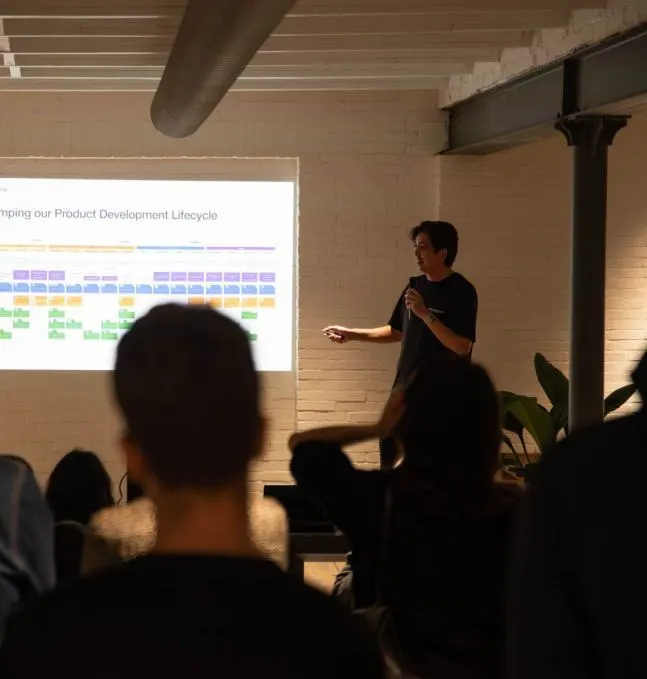
The full playbook and a call with Dale
The full whitepaper covers the methodology, the three conversations in detail and the free Miro template. If the readiness check surfaced gaps, Dale can walk you through what to fix first.
Use the free Miro templateQuestions about the whitepaper
Our other whitepaper covers how we vet engineers for this way of working.
The Next 10X EngineerWho is this whitepaper for?
Product and engineering leaders who've been asked to adopt AI and have to turn that into a working method for their team: heads of product, CPOs, CTOs and founders.
Why does AI stall in agile teams?
Agile keeps specs loose because code used to be expensive. AI needs structured input, and every handover between discovery, design and engineering loses some context. People fill the gaps from memory; agents can't, so the output gets worse as work moves through the process.
How do I know if my team is ready?
The seven questions in the readiness check will tell you. Five or more yeses means you can start, three or four means you have specific gaps to close and two or fewer means the foundation comes first.
Is the whitepaper free?
Yes, you can read it free in our document viewer. The Miro template it describes is free too.
Get a shortlist within five working days
You share the roles and the stack in a short form or a thirty-minute call. Within five working days you get named senior engineers to review, each with both scorecards.
 ISO 27001
Certified